

Tampa Short-Term Rental Laws | What to Check Before Buying The Property
Tampa Short-Term Rental Laws | What to Check Before Buying The Property
By: John Ishmael Acuyado | November 12, 2026
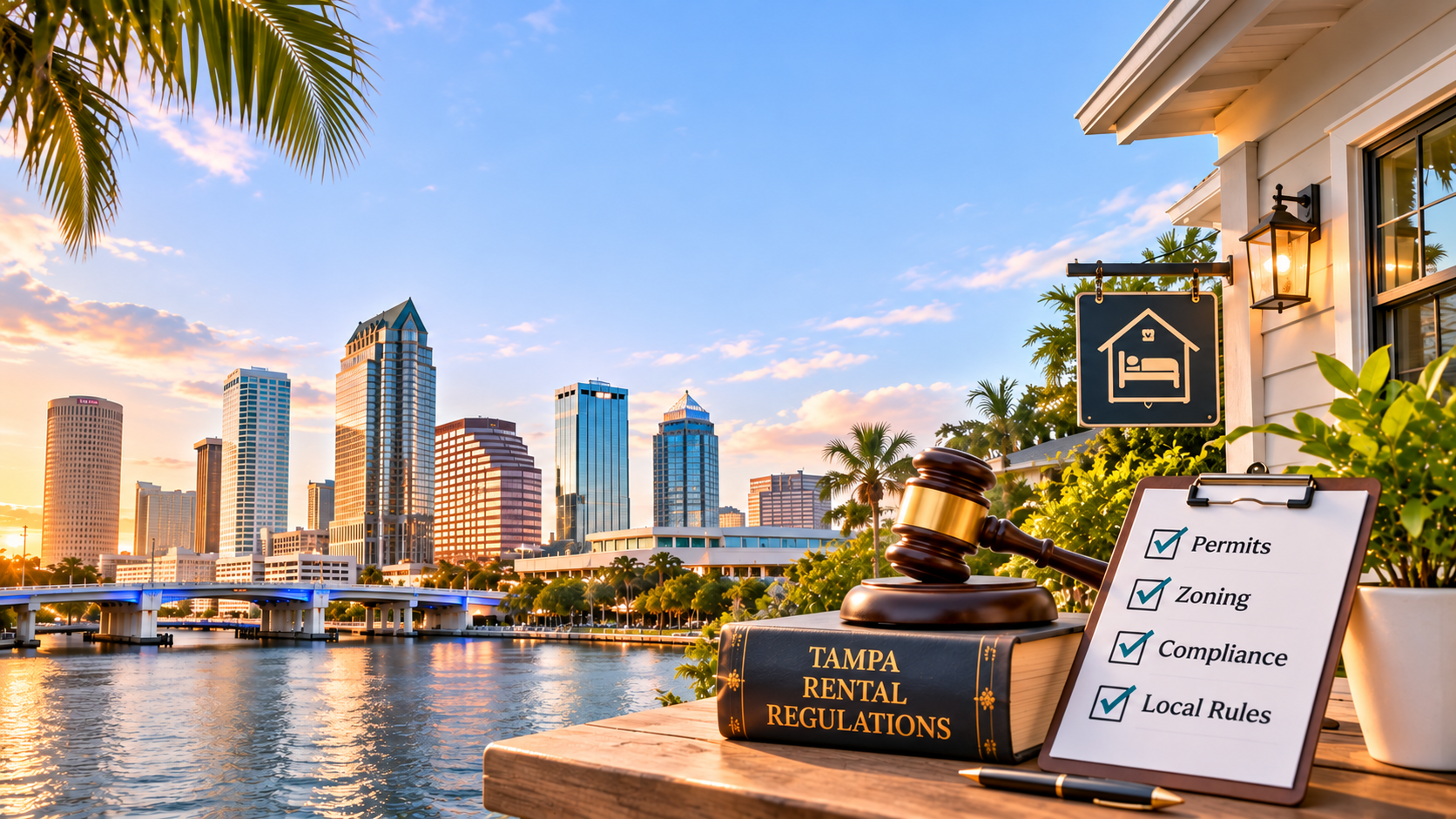
Tampa Short-Term Rental Laws | What to Check Before Buying The Property
Tampa short-term rental laws depend on a property's exact jurisdiction, not simply its mailing address. A home inside the City of Tampa can face different zoning rules from one in unincorporated Hillsborough County. Qualifying rentals also need attention to Florida vacation rental licensing, business taxes, lodging taxes, and private deed restrictions.
Hillsborough County adopted additional short-term rental registration rules for its unincorporated areas, scheduled to begin January 1, 2027. Before making an offer, investors should verify the parcel's governing authority, planned rental use, licenses, and operating requirements in writing.
Last reviewed: November 11, 2026. This guide provides general information, not legal or tax advice. Verify current requirements for the specific property before purchasing or operating.
First, Determine Which Tampa-Area Government Regulates the Property
A “Tampa, FL” address can describe a location inside Tampa city limits or elsewhere in Hillsborough County. That distinction affects zoning, business tax requirements, and whether the county's forthcoming registration ordinance applies.
Temple Terrace and Plant City are separate municipalities with their own governing rules.
Start with the property's folio or parcel number rather than relying on a listing description. The City of Tampa's interactive zoning map displays city limits, zoning districts, and overlay information.
For an unincorporated parcel, consult the Hillsborough County Land Development Code and map resources.
Then send the zoning office an address-specific question:
“May this property be rented as an entire dwelling for stays of two to six nights, without the owner present?”
State the intended minimum stay, guest capacity, property type, and any special use such as events. Request a written interpretation identifying relevant zoning provisions, permits, and overlays.
A map result is a starting point, not a permit or legal assurance.
Are Nightly Airbnb Rentals Legal in the City of Tampa?
There is no defensible citywide yes-or-no answer for every property. City zoning and the use proposed by the buyer matter.
A particularly instructive decision is Super Host, LLC v. City of Tampa (2022), involving an RS-60 South Tampa property.
The appellate division upheld zoning violations associated with a rental shorter than seven days and occupancy by more than four unrelated people; it reversed and remanded the treatment of the fine.
The decision concerned the applicable code and facts of that case, not a universal minimum stay for every Tampa parcel.
Florida law also complicates broad claims.
Florida Statutes §509.032(7) generally prevents local governments from banning vacation rentals or newly regulating their duration or frequency, while recognizing an exception for qualifying local regulations adopted on or before June 1, 2011.
Whether a specific Tampa provision is applicable and enforceable is a question for the appropriate city staff and, when necessary, Florida counsel.
Before an offer: Ask for written verification of the exact zoning district, whether the proposed whole-home or room-rental model is allowed, what stay lengths and guest arrangements the city will recognize, and any outstanding code cases.
A current online listing or seller's booking history does not substitute for that answer.
What's Changing for Unincorporated Hillsborough County in 2027?
On September 2, 2026, Hillsborough County commissioners adopted new registration and operating requirements for short-term vacation rentals in unincorporated Hillsborough County, with an announced effective date of January 1, 2027.
The change does not automatically apply to properties inside the City of Tampa, Temple Terrace, or Plant City.
As of the City's November 5, 2026 meeting, Tampa City Council had received a staff update and had not adopted the county's ordinance at that meeting.
Contemporaneous reporting on the county vote identifies annual property registration, a reported $200-per-unit annual fee, and a designated contact who can respond to rental issues.
Reports also describe requirements addressing guest conduct, noise, trash, parking, and county inspection access.
Before relying on these reported details, obtain the final adopted ordinance and fee resolution to confirm the precise definitions, fees, deadlines, exemptions, inspection process, and penalties directly with the county.
If an investment will begin accepting guests in 2027, a buyer should not base the financial model solely on 2026 operating conditions.
Allow for registration and compliance administration, potential changes in vendor or local-contact arrangements, and an update to the underwriting before closing.
Registration would not, by itself, prove that the underlying zoning permits the buyer's proposed use.
For county parcels, review the official Hillsborough County ordinance information and obtain the adopted ordinance and fee resolution from County Code Enforcement or the Clerk.
For city parcels, confirm whether Tampa has taken further action after the November 5, 2026 council update.
Florida Vacation Rental License Requirements for Investors
Florida's Department of Business and Professional Regulation (DBPR) licenses qualifying vacation rentals.
Under Florida Statutes §§509.013 and 509.242, transient public lodging can include a unit rented more than three times in a calendar year for stays of fewer than 30 consecutive days, or advertised as regularly available for such stays.
Statutory exclusions and the precise accommodation classification matter; not every room rental is treated as an entire-unit vacation rental.
The DBPR vacation rental guide distinguishes whole-unit vacation rentals from renting individual rooms and identifies condominium and dwelling license classifications.
The agency's published fees for a new single-unit, full-year vacation rental license comprise:
- $50 application fee
- $10 hospitality education fee
- $170 license fee
Timing, license type, and renewal cycles can change the amount due. Hillsborough County belongs to DBPR's Tampa district, with a February 1 annual renewal date.
One important acquisition point: a DBPR lodging license cannot be transferred from one owner or location to another.
Buyers should budget for their own application and clarify the opening date and transition of reservations rather than assuming they inherit the seller's permission.
DBPR licensing also does not override local zoning, association restrictions, building requirements, or taxes.
Ask the seller for their license number and compliance history, and independently verify those records with DBPR.
If the property is advertised for short stays but lacks a required license, treat that as a due-diligence issue rather than a reason to assume licensing is optional.
Business Tax Receipts and Tampa Short-Term Rental Taxes
A legitimate investment plan needs separate checks for business tax receipts and taxes on guest stays.
These are not the same as land-use approval.
The City of Tampa states that landlords operating for private gain must obtain the applicable city business tax receipt.
It also says the former city rental-certificate/registration requirement was repealed effective May 4, 2023; the business tax obligation remains.
The Hillsborough County Tax Collector provides local business tax registration guidance. Confirm which receipts and classifications apply to the specific operator and parcel.
For qualifying transient rentals, the principal tax layers are:
- Florida transient rental tax: 6% under Florida Statutes §212.03, subject to applicable definitions and exemptions.
- Hillsborough discretionary sales surtax: 1.5% in the Florida Department of Revenue's 2026 county surtax schedule, for taxable transactions to which the surtax applies.
- Hillsborough tourist development tax: 6% on qualifying accommodations rented for six months or less, according to the County Tax Collector.
The DBPR licensing threshold for certain short stays and the separate six-month lodging-tax rules are different tests.
A property does not become automatically tax-exempt just because an operator switches from nightly to monthly bookings.
Equally, a marketplace may collect some taxes without handling every account or direct booking obligation for the owner.
Obtain confirmation of platform collection, state registration, county filings, any exemptions, and the rate applicable when operations begin.
Recheck 2027 rates rather than treating the 2026 schedule as permanent.
For underwriting, distinguish gross booking revenue from actual investment performance.
The business has potential expenses for taxes, cleaning, repairs, insurance, utilities, payment processing, local compliance, vacancy, and debt service.
Avoid treating gross receipts as profit or projecting guaranteed returns.
Private Restrictions, Occupancy, Parking, and Safety
Public licensing is only part of the picture.
A condominium declaration, homeowners' association rules, or recorded deed restriction may limit lease length or frequency even where local zoning otherwise permits the use.
Florida's condominium and HOA statutes address when amendments restricting rentals bind owners, but the treatment differs by property type and circumstance.
The most reliable approach is to examine the actual recorded documents and ask a Florida attorney to evaluate how they apply to a purchaser.
Request the current declaration and amendments, rules and regulations, lease application forms, approval fees, board minutes discussing rentals, pending proposed amendments, and any seller correspondence with the association.
A seller's account of “grandfathered” rental rights is not proof that those rights survive a change of ownership.
Independently verify approved occupancy, bedroom count, parking arrangements, building permits, life-safety features, pool barriers where applicable, insurance eligibility, and any active code-enforcement matters.
These details affect both guest operations and a property's defensibility as an investment.
For a property that will use a local contact or property manager, confirm the intended response process rather than assuming a third party will cure every compliance issue.
Short-Term Rental Purchase Checklist: Before the Offer and Before Closing
Use the following questions to turn general Tampa Airbnb rules into property-level decisions.
- Confirm jurisdiction and zoning. Save the folio number, city or county boundary determination, zoning district, overlay maps, and written staff response for the intended stay length and rental format.
- Describe the operating model. Document whole-home versus room rentals, owner occupancy, target minimum stay, guest count, parking, and any planned events.
- Request association and title documents. Review recorded restrictions and amendments, rental approvals, pending rule changes, and any outstanding violations or liens.
- Verify licenses and future registration. Review the seller's DBPR status, plan the buyer's new license application, and determine whether 2027 county registration applies.
- Reconcile tax accounts. Confirm Florida sales/surtax, Hillsborough tourist development tax, and any applicable city or county business tax receipts, including direct bookings and marketplace remittances.
- Inspect safety and operating conditions. Check permits, fire and building requirements, pool safety, parking, property condition, insurance, and code-enforcement history.
- Test the investment economics. Model realistic occupancy and expenses, plus compliance costs, tax treatment, slower bookings, repairs, and a scenario in which the intended STR use is not approved.
- Resolve unknowns before removing contingencies. Ask the seller, local planning office, DBPR, title company, lender, accountant, insurance adviser, and Florida counsel the questions within their respective expertise.
A useful local STR-focused Realtor can help organize the parcel research, request records, identify conflicts between marketing claims and official documents, and coordinate the right professionals.
The Realtor does not replace the government official who confirms zoning or the attorney who advises on legal enforceability.
Frequently Asked Questions About Tampa STR Rules
Is Airbnb Legal in Tampa, Florida?
Some Tampa-area properties may be eligible for short-term rental use, but legality depends on the exact parcel, zoning, proposed operation, state licensing, and private restrictions.
Do not infer permission from the city name, a neighboring listing, or a seller's reservation calendar.
Does Hillsborough County's 2027 Ordinance Apply Inside the City of Tampa?
Not automatically. The ordinance adopted in September 2026 was directed at unincorporated Hillsborough County and is scheduled to take effect January 1, 2027.
Tampa City Council discussed the subject on November 5, 2026 without adopting the same ordinance at that meeting.
Check the city's latest formal actions before publishing or buying.
Do I Need a Florida Vacation Rental License for a 30-Day Stay?
It depends on the property's classification, how stays are offered and advertised, and the statutory exclusions.
A 30-day operating strategy should be reviewed under DBPR's rules rather than assumed to eliminate every licensing duty.
State and local tax tests are separate, and even longer stays may remain subject to some taxes.
Can I Use the Seller's Airbnb Permit or DBPR License After Closing?
Do not assume so.
Florida's lodging license is not transferable between owners.
Apply for the buyer's required DBPR license, and separately ask the relevant city or county whether any local registration, exception, or approval survives the sale.
Does Airbnb Collect All Short-Term Rental Taxes in Hillsborough County?
Platforms may collect and remit certain taxes on qualifying transactions, but collection arrangements vary.
Owners should confirm which state and county taxes are handled for each platform and remain responsible for understanding their own registration, filing, and direct-booking obligations.
Does an HOA Have the Power to Restrict Short-Term Rentals?
Potentially, yes.
The recorded declaration, current rules, dates of amendments, property type, and applicable Florida law matter.
Ask for complete documents and obtain property-specific legal advice rather than relying on verbal statements that rentals are permitted.
Get Property-Specific Help Before Committing to a Tampa STR Purchase
A promising address is only the beginning.
The better decision comes from checking whether your intended operating model fits that parcel's zoning, licensing requirements, private restrictions, and real-world expenses before you commit to the purchase.
STR Realtor Search's free Florida Realtor-matching service connects investors with local STR-focused real estate professionals who can help coordinate property research and due diligence.
A Realtor can help organize the investigation while local officials, licensed attorneys, lenders, and tax professionals determine issues within their authority.
That process gives buyers a clearer basis for deciding whether to proceed, renegotiate, change the rental strategy, or walk away.
