
Scottsdale AZ Short-Term Rental Laws: What Buyers Need to Know
Scottsdale AZ Short-Term Rental Laws: What Buyers Need to Know
By: John Ishmael Acuyado | November 23, 2026

Scottsdale AZ Short-Term Rental Laws: What Buyers Need to Know
Scottsdale short-term rentals are generally legal, but buying a home that can be rented for a few nights is not the same as buying a business that is ready to operate. Arizona law limits a city's ability to prohibit vacation rentals, while Scottsdale requires an annual short-term rental license and applies safety, notification, tax, and residential-use rules. Private HOA or condominium restrictions may also prevent the rental strategy you have in mind.
For an investor, the first step is to verify the specific property's jurisdiction, lawful configuration, private restrictions, and compliance costs before relying on any projected booking revenue. The following guide explains the main Scottsdale AZ short-term rental laws and what to investigate before an offer or closing.
Are Short-Term Rentals Legal in Scottsdale, AZ?
Yes. Arizona Revised Statutes § 9-500.39 generally prevents cities and towns from prohibiting vacation rentals and short-term rentals solely because of that use. Scottsdale permits short-term rentals in residential neighborhoods, subject to other applicable laws and restrictions. That state protection does not override private covenants or eliminate licensing and residential-use requirements.
Scottsdale's licensing program generally covers properties offered for stays of fewer than 30 days. It is distinct from the city's rules for rentals lasting 30 days or longer. A home advertised with a Scottsdale postal address is not necessarily located inside Scottsdale city limits, however. An investor should use the parcel number and the city's Property Information Request system to identify the regulating municipality. A property outside city limits may be governed by another municipality or the unincorporated-county framework instead.
Buyer takeaway: Establish jurisdiction before interpreting the regulations. A permitted use in the city does not establish that an HOA, condominium association, deed restriction, or unusual property configuration allows the planned rental.
Which Scottsdale Properties Can Be Short-Term Rentals?
Scottsdale describes eligible vacation rentals broadly enough to include qualifying single-family and multifamily dwelling units. Its city guidance says the use is generally permitted in residential neighborhoods, while retaining residential occupancy standards and prohibiting nonresidential commercial activities. Whether a particular residence can be offered as planned depends on its legally approved units and private documents.
A guest house is not the same as an accessory dwelling unit (ADU) in Scottsdale. The city says accessory guest houses must be rented together with the main dwelling, not independently. A properly approved ADU may be separately rented, but the city publishes owner-residency conditions when an ADU is used for short-term renting.
Arizona law includes a distinction for ADUs whose final approval was issued on or before September 13, 2024, versus on or after September 14, 2024. Because that distinction can affect the outcome, an investor with an older detached unit should obtain the permits, certificate dates, and a property-specific determination rather than assuming separate rentals are permitted.
Similarly, an attractive condo or townhome can be unsuitable for the proposed business if its recorded covenants or association rules prohibit stays under a certain duration. Request the current governing documents, amendments, and any rental approval process before removing contingencies.
Scottsdale Short-Term Rental License Requirements
Scottsdale requires a separate annual city license for each short-term rental property, with a published annual fee of $250 per property. The city directs operators through the following compliance steps:
- Obtain an Arizona Transaction Privilege Tax (TPT) license. Register with the Arizona Department of Revenue and ensure the Scottsdale location uses region code SC. The TPT number is needed for the city application.
- Apply for the Scottsdale short-term/vacation rental license. Supply the required ownership, property, and emergency-contact information through the city's licensing process. Arizona law establishes a seven-business-day decision period after the city receives the required application information, subject to statutory conditions; that is not a promise of instant approval.
- Notify neighbors and document liability coverage. Scottsdale's owner instructions describe notifying adjacent properties, homes directly and diagonally across the street, or units on the same floor of a multifamily building, and completing the compliance attestation. State law refers to notice before the rental is first offered; Scottsdale's published instructions refer to notification within 30 days after license issuance. To avoid relying on the less protective timeline, arrange notice before initially advertising and confirm the procedure with the city.
- Register the residential rental with Maricopa County. Scottsdale directs owners to satisfy A.R.S. § 33-1902 before rental occupancy. Verify that the assessor's ownership and rental information is current.
- Display the required notice inside the property. Scottsdale specifies a protected notice in at least 14-point bold type near the front door and primary backyard access, covering safety equipment and relevant local information.
Operators should also keep emergency contacts current. These steps involve different agencies, so a city license by itself does not prove that every state, county, or private requirement has been satisfied.
Occupancy, Noise, Parking, and Event Rules
A legal vacation rental remains a residence. Scottsdale says dwelling units, including vacation rentals, are subject to a maximum family size of six adults and their related dependent children. The rule should not be casually converted into an occupancy promise for every possible group. Before marketing a home to large groups, verify the city's interpretation for the intended guests, the approved building configuration, and any fire-safety or association limits.
Scottsdale also enforces general rules concerning noise, nuisance parties, waste, traffic, and parking. The city's resident guidance states that after 10 p.m., outdoor activity should remain at conversational volume. Ordinary residential gatherings are not automatically illegal; disruptive, excessive, or commercial uses may be.
A particularly important distinction is overnight lodging versus an event venue. Scottsdale's 2026 Ordinance 4719 clarified the definition of an event center to strengthen enforcement against commercial weddings, large parties, corporate events, and similar activities at short-term rentals. Investors should not build event-venue revenue into projections for an ordinary residential STR unless the intended use has been independently approved under the applicable rules.
Pool Safety, Insurance, and Guest Information
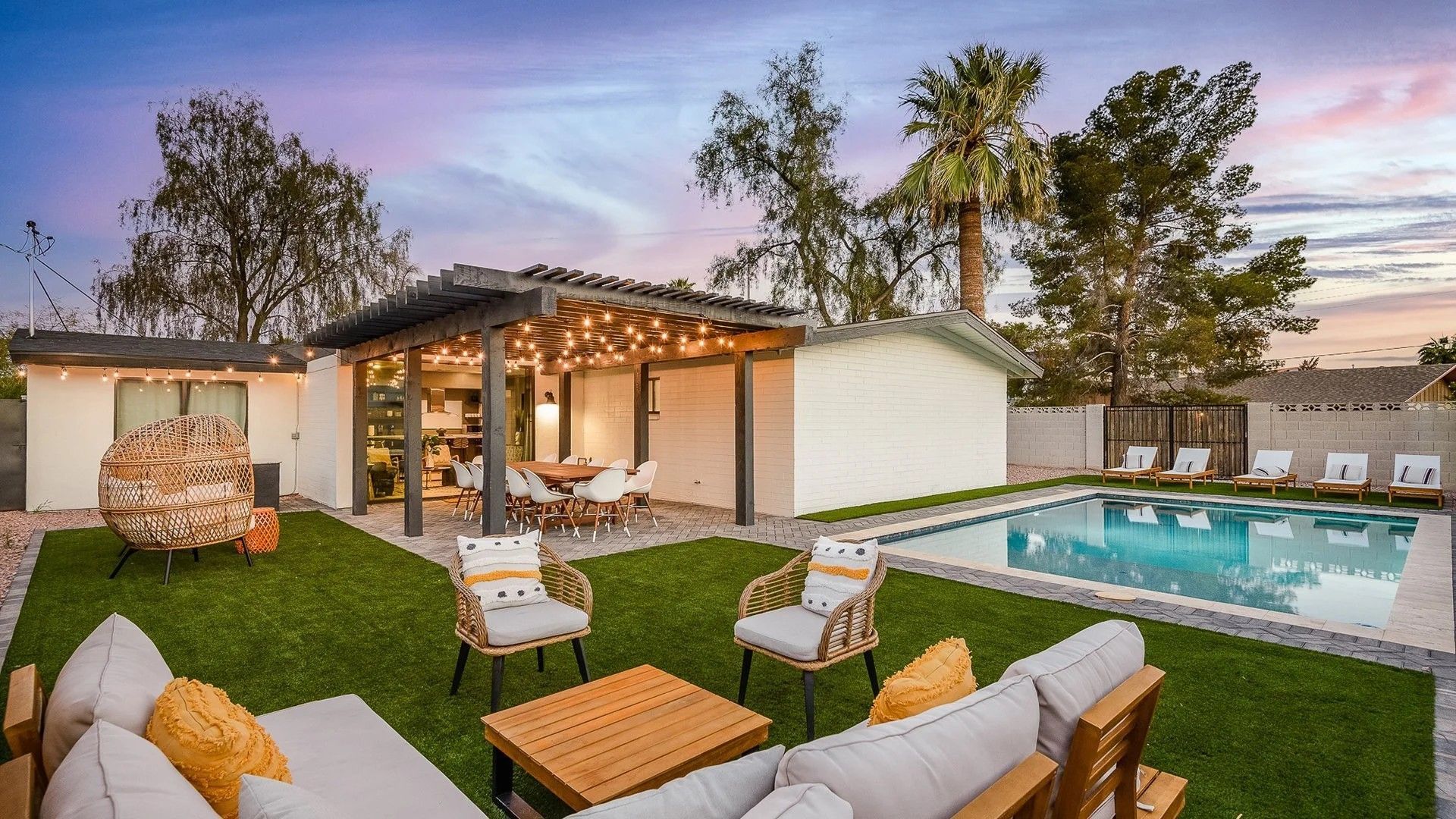
A pool can be attractive to prospective guests, but it can also create a material compliance expense. For Scottsdale STRs with a pool, spa, or hot tub, the city requires a primary perimeter barrier at least 60 inches high, with appropriate self-closing and self-latching gates. It also requires a secondary barrier, such as a compliant separate pool fence or audible alarms on access doors and windows. Scottsdale provides more detailed requirements for gate latches, vehicle gates, and spa covers.
Do not rely on the property's age or on a seller's statement that the backyard fence is sufficient. Have the actual barrier configuration reviewed against the city's STR standards and budget for any repairs before launching the rental.
Arizona law also allows the city to require at least $500,000 of appropriate liability insurance, or qualifying equivalent coverage through an online lodging marketplace. Marketplace coverage should not automatically be treated as comprehensive protection for direct bookings, exclusions, or other owner risks. Confirm coverage with an insurance professional and keep documentation available for licensing.
Scottsdale Short-Term Rental Taxes
A Scottsdale STR has tax obligations beyond the annual city license fee. The Arizona Department of Revenue administers the relevant Transaction Privilege Tax (TPT) and transient lodging taxes. Scottsdale's current tax guidance identifies a 1.70% city privilege tax rate and an additional 5.00% city transient lodging tax for qualifying short stays; applicable state and county components must also be considered. These city percentages are not a substitute for an address-specific combined lodging tax calculation.
The city updated its basic privilege tax rate effective July 1, 2025. Some older Scottsdale FAQ wording still shows 1.75%, so investors should use the city's more recent tax page and ADOR classification guidance rather than copying an outdated number.
Airbnb, Vrbo, or another lodging marketplace may collect certain taxes on eligible marketplace transactions, but that does not establish that the owner has no registration, reporting, or direct-booking obligations. Reconcile marketplace receipts with direct reservations and have an Arizona tax adviser confirm the correct filing treatment.
From an investment perspective, taxes collected from guests are not rental profit. Build your forecast around net receipts after operating expenses, cleaning, maintenance, insurance, utilities, management, debt service, replacements, and other ownership costs.
What Happens to an STR License When You Buy the Property?
A seller's past Airbnb operation is useful evidence of a business history, not proof that a buyer can take over and begin renting without changes. Scottsdale's license system records property and operator information, and the city requires ownership and emergency-contact details to remain current. Before closing, confirm directly with Scottsdale whether a new-owner application is needed, what the transition process requires, and when bookings may legally begin. Do not assume the seller's approval, listing account, or tax registration automatically transfers.
Review the property's license status through Scottsdale's Short-Term Rental Resource Center, but also seek records of open complaints, safety violations, and past enforcement. Arizona law permits escalating civil penalties for verified violations and, in defined circumstances, suspension of an STR permit or license for up to 12 months. A verified violation means more than an unsubstantiated complaint, and penalties are not imposed automatically in every case.
When evaluating a purchase with existing reservations, document who is responsible for cancellations, guest communication, taxes, insurance, and compliance during the ownership change. If a gap in lawful operations is possible, reflect it in the cash-flow model instead of assuming uninterrupted revenue.
Scottsdale STR Buyer Due Diligence Checklist
Use this checklist before removing a contract contingency:
| Verify | Documents or actions |
|---|---|
| Jurisdiction and zoning | Parcel number, city-limit confirmation, zoning district, lawful rental use |
| Unit configuration | Building permits, guest-house or ADU classification, final approval dates |
| Private restrictions | HOA/condo CC&Rs, bylaws, rental policies, recorded deed restrictions |
| Licenses and taxes | Scottsdale license status, owner-change procedure, Arizona TPT registration |
| County requirements | Maricopa County residential rental registration and ownership details |
| Safety and operating limits | Pool barriers, insurance, posted notices, emergency contacts, occupancy and nuisance rules |
| Compliance history | Prior citations, open complaints, unpaid penalties, suspended approvals |
| Business performance | Booking statements, seasonality, average daily rate, realistic costs and capital budget |
| Closing plan | Applications, notice timing, existing bookings, transition responsibilities |
A short-term rental-focused Realtor can help coordinate the search for these materials and identify questions to raise with city staff, the association, an attorney, an insurer, or a tax professional. Property-specific legal clearance must come from the appropriate authority or qualified adviser, not from a revenue projection.
Frequently Asked Questions About Scottsdale Short-Term Rental Laws
Can I operate an Airbnb in Scottsdale, Arizona?
Generally, yes. Arizona law prevents Scottsdale from broadly prohibiting short-term rentals, but a qualifying rental for fewer than 30 days must follow Scottsdale's license, safety, notice, tax, and other applicable rules. HOA or deed restrictions may still prohibit the intended use at a particular property.
How much is a Scottsdale short-term rental license?
Scottsdale lists an annual fee of $250 per property. This is separate from tax registration, insurance, pool-safety upgrades, and other possible costs. Check the fee again at the time of application.
Can an HOA prohibit short-term rentals in Scottsdale?
Yes, private covenants and association restrictions can regulate rental duration or use even where the city generally permits STRs. Review the current recorded documents and any amendments before buying, rather than relying on a listing agent's description.
Can I rent out a Scottsdale guest house or ADU separately?
The city says a conventional accessory guest house cannot be rented separately from the main home. An approved ADU is a different land use, but owner-residency and approval-date rules may apply to its short-term rental use. Confirm the unit's permit history and exact eligibility with Scottsdale.
Does a Scottsdale STR license transfer when the property sells?
Do not assume that it does. The city's current published instructions confirm property-specific annual licensing, but buyers should ask the licensing office to verify the ownership-transfer rule and any fresh application steps for the exact property before closing.
Find a Scottsdale Realtor Who Understands STR Due Diligence
Choosing a Scottsdale investment property involves more than estimating nightly rates. A local professional who understands short-term rental purchases can help you assess neighborhood fit, review available operating records, and coordinate the due-diligence questions that matter before you commit.
STR Realtor Search's free Scottsdale Realtor connection service can help buyers connect with an STR-focused local Realtor. The service is a starting point for an informed purchase process, not a substitute for legal, tax, insurance, or municipal approval.